Better Coffee Starts After Harvest: What Research Reveals
Coffee processing plays an important role in determining the final quality, aroma and flavor of coffee. While coffee varieties and growing conditions matter, the steps taken after harvesting can also influence the characteristics of the finished product.
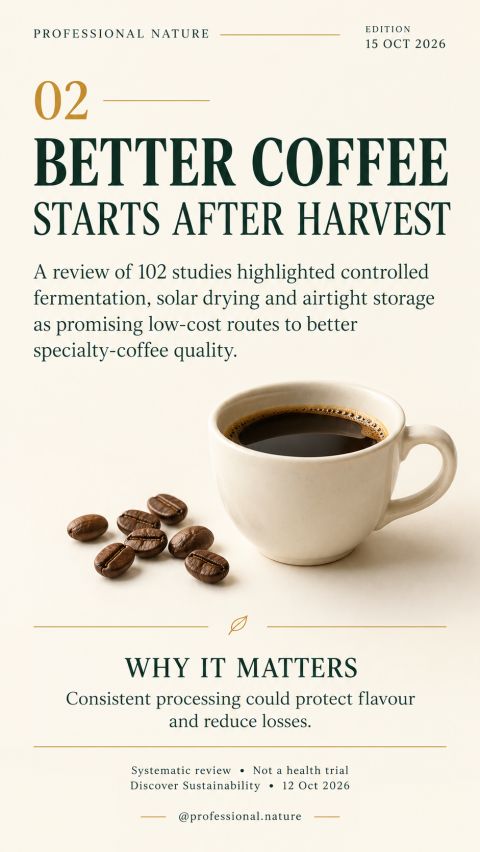
A systematic review published in Discover Sustainability on 12 October 2026 examined findings from 102 studies on post-harvest practices.
The review highlighted controlled fermentation, solar drying and airtight storage as promising approaches for improving specialty coffee quality while potentially reducing production losses.
Why Does Coffee Processing Matter?
Coffee cherries undergo several stages before becoming roasted coffee beans.
These stages may include fermentation, drying, sorting and storage.
Each step can influence moisture levels, chemical composition and sensory characteristics.
Poor handling may lead to inconsistent flavor, deterioration or product losses.
Carefully managed processing can help producers maintain more consistent quality.
Controlled Fermentation and Coffee Flavor
Fermentation is an important stage in several coffee production methods.
During fermentation, microorganisms interact with compounds present in the coffee cherry.
These processes can influence the development of aroma and flavor characteristics.
Controlled fermentation aims to manage conditions such as temperature, duration and microbial activity.
Better control may help producers achieve more consistent sensory profiles.
However, fermentation outcomes depend on coffee variety, environmental conditions and processing methods.
Can Solar Drying Improve Coffee Quality?
Drying helps reduce moisture content to levels suitable for safe storage.
Solar drying uses sunlight as an energy source and may offer a relatively affordable option for coffee producers.
When properly managed, it can support moisture reduction while limiting dependence on conventional energy sources.
However, drying conditions require careful monitoring.
Excessive moisture, uneven drying or exposure to unfavorable weather can affect product quality.
The effectiveness of solar drying therefore depends on suitable equipment and environmental conditions.
Why Is Airtight Storage Important?
Storage conditions can influence coffee quality long after harvesting.
Exposure to moisture, oxygen and unfavorable temperatures may contribute to deterioration.
Airtight storage systems can help protect properly dried coffee from changes in environmental humidity.
They may also reduce certain quality losses during storage.
However, airtight packaging cannot correct problems caused by inadequate drying or poor handling before storage.
How Can Better Processing Reduce Losses?
Post-harvest losses can affect both product quality and economic returns.
Improved handling may help producers reduce waste and maintain more consistent batches.
Affordable technologies are particularly relevant for small and medium-sized coffee producers.
Controlled fermentation, suitable drying systems and improved storage can form part of a broader quality-management strategy.
However, the financial benefits depend on local conditions, equipment costs and implementation.
What Did the Review Actually Establish?
The publication reviewed 102 existing studies rather than conducting a new clinical or consumer trial.
Its findings identified promising approaches for improving coffee quality.
However, results may vary across different coffee-growing regions, processing facilities and production systems.
The review does not establish that one processing method is always superior.
Further research and practical validation can help determine which combinations produce reliable results.
What Does This Mean for Specialty Coffee?
Specialty coffee producers increasingly focus on traceability, consistent flavor and careful post-harvest handling.
Processing decisions can influence the sensory experience that consumers associate with premium coffee.
Fermentation, drying and storage should therefore be considered important parts of quality management.
Better processing does not necessarily mean more complicated processing.
In some cases, relatively accessible methods may help improve consistency when applied correctly.
Takeaway
Coffee processing can influence the quality of the final product long before roasting begins.
A systematic review of 102 studies highlighted controlled fermentation, solar drying and airtight storage as promising approaches for specialty coffee production.
These methods may support flavor consistency and help reduce losses.
However, their effectiveness depends on proper implementation and local production conditions.
The research reinforces an important message: producing better coffee begins with careful handling after harvest.
Research source: Discover Sustainability, 12 October 2026 — Systematic Review.