Chia Seeds: Why Grinding Matters for Nutrient Accessibility
Ground chia seeds may release more nutrients during digestion than whole chia seeds. Recent laboratory research suggests that food preparation can influence how certain nutritional compounds become accessible.
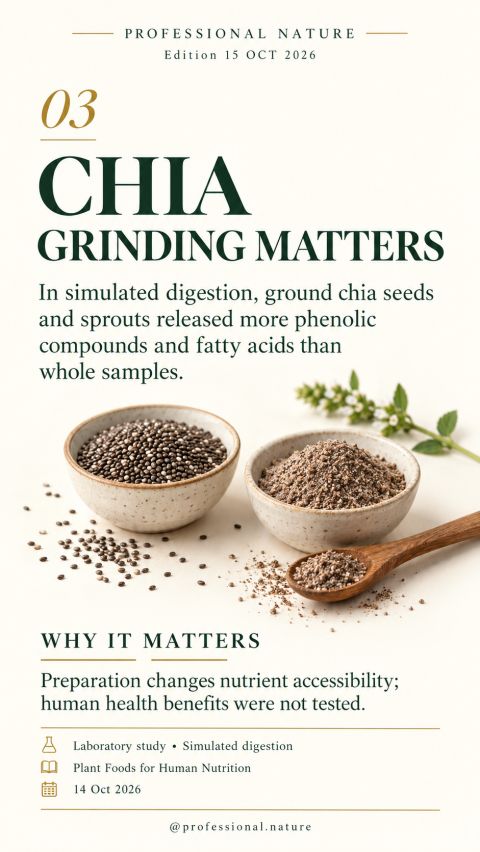
A study published in Plant Foods for Human Nutrition on 14 October 2026 investigated the release of phenolic compounds and fatty acids from chia seeds and sprouts during simulated digestion.
The researchers found that grinding increased the release of these compounds compared with whole samples.
However, the study did not investigate nutrient absorption or health outcomes in humans.
What Did the Research Find?
Researchers compared whole and ground chia samples under laboratory conditions designed to simulate digestion.
The findings showed that ground chia seeds and sprouts released more phenolic compounds and fatty acids than their whole counterparts.
This suggests that the physical structure of a food can influence how its components become available during digestion.
However, laboratory nutrient release does not necessarily mean that the human body absorbs or uses more of those nutrients.
Why Does Grinding Matter?
Chia seeds have an outer structure that protects their internal components.
When seeds remain whole, this structure may limit the release of some compounds during digestion.
Grinding breaks down the physical structure and exposes more of the seed’s contents.
As a result, digestive processes may access certain nutrients more easily.
This principle is relevant to food science because processing methods can change how nutrients behave during digestion.
What Nutrients Do Chia Seeds Contain?
Chia seeds contain several nutritionally important components.
These include dietary fiber, plant-based protein, fats and minerals.
They are particularly known for containing alpha-linolenic acid (ALA), a plant-derived omega-3 fatty acid.
Chia also contains phenolic compounds, which researchers study for their antioxidant activity.
However, the presence of these compounds does not automatically establish specific clinical benefits.
Their effects depend on factors such as dietary intake, digestion, absorption and overall nutritional status.
What Are Phenolic Compounds?
Phenolic compounds are naturally occurring substances found in many plant foods.
They contribute to several biological and chemical properties of plants.
Researchers investigate their potential roles in antioxidant activity and other biological processes.
However, laboratory antioxidant measurements cannot independently demonstrate that a food prevents disease.
Human clinical studies are necessary to establish meaningful health effects.
Ground Chia Seeds and Nutrient Accessibility
The study suggests that ground chia seeds may provide greater accessibility to certain compounds during simulated digestion.
This is an important distinction from simply measuring the total nutrient content of a food.
Two samples may contain similar amounts of a nutrient but release different quantities during digestion.
Food scientists use simulated digestion models to investigate these differences.
Nevertheless, such models cannot fully reproduce the complexity of human digestion, absorption and metabolism.
What About Chia Sprouts?
The research also examined chia sprouts.
Sprouting involves the early growth of a seed under suitable environmental conditions.
During germination, biochemical changes may influence the composition and accessibility of certain nutrients.
In this study, grinding also increased the release of selected compounds from sprouted samples.
However, the findings do not establish that sprouts are nutritionally superior for every purpose.
Does Grinding Make Chia Healthier?
The study does not prove that eating ground chia produces better health outcomes than eating whole chia.
It demonstrates differences in compound release under simulated digestive conditions.
Greater release in a laboratory model may be relevant to nutrient accessibility, but human studies are needed to determine whether it leads to greater absorption or measurable health benefits.
Therefore, claims about disease prevention or improved metabolic health would go beyond the evidence presented.
Practical Considerations
Both whole and ground chia can be included in a varied dietary pattern.
Ground chia may be useful in smoothies, yogurt and other foods where a finer texture is preferred.
Because grinding exposes more of the seed’s fats to oxygen, appropriate storage is important.
Freshly ground chia should be stored in a sealed container and protected from excessive heat and light.
Consumers should also consider overall dietary variety rather than relying on one ingredient for nutritional benefits.
Why Does This Research Matter?
The findings highlight an important principle in nutrition science: food preparation can influence nutrient accessibility.
Grinding, cooking, soaking and other processing methods may change the physical or chemical properties of foods.
However, the effects differ between ingredients and preparation methods.
Researchers must evaluate both nutrient release and actual human health outcomes before making clinical recommendations.
Takeaway
Ground chia seeds and sprouts released more phenolic compounds and fatty acids than whole samples during simulated digestion.
The results suggest that grinding can influence nutrient accessibility.
However, the research was conducted under laboratory conditions and did not demonstrate improved nutrient absorption or health outcomes in humans.
The study offers useful insights into food processing while highlighting the need for further clinical research.
Research source: Plant Foods for Human Nutrition, 14 October 2026 — Laboratory Study Using Simulated Digestion.