Cashew Apple Waste and New Food Potential
Cashew apple waste is gaining attention as a possible ingredient for new food products. Cashew processing can leave behind fruit material that still contains useful nutrients and other compounds. Researchers are studying whether this material can be transformed into valuable food ingredients instead of being discarded.
Turning food-processing leftovers into useful ingredients could also support more efficient use of agricultural resources.
Why Study Cashew Apple Waste?
Food production creates large amounts of by-products. Some of these materials still contain fiber, carbohydrates, minerals, and bioactive compounds. Researchers can therefore investigate new ways to use them in food development.
Cashew apple waste is one example. Instead of treating the remaining fruit material only as waste, scientists can study its composition and potential applications.
The Role of Fermentation
Fermentation may change the nutritional and functional properties of plant materials. Microorganisms can transform certain compounds during this process. As a result, researchers are exploring fermentation as one method for improving food-processing by-products.
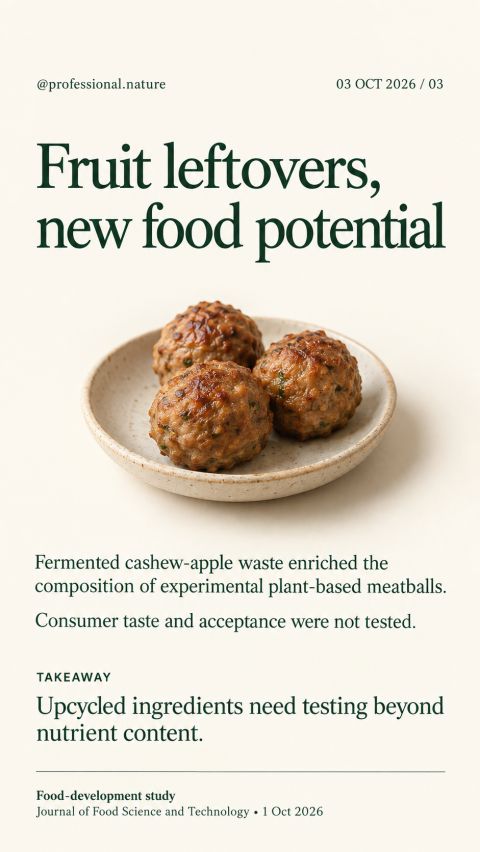
In this research, fermented cashew apple waste was used to enrich experimental plant-based meatballs. The study examined how the ingredient affected the composition of the experimental food.
The results showed that the fermented material could modify the nutritional composition of the product. However, nutritional composition alone does not tell us whether consumers will enjoy or accept a new food.
From Nutrition to Consumer Acceptance
A successful food product needs more than an interesting nutritional profile. Taste, aroma, texture, appearance, stability, and safety are also important.
For this reason, researchers need to evaluate upcycled ingredients carefully before introducing them into commercial foods. Consumer testing is especially important because a nutritionally promising ingredient may still affect flavor or texture.
Cashew apple waste therefore represents an interesting opportunity, but further research is necessary to understand its practical value in food development.
Food Upcycling and Sustainability
Using agricultural by-products could help reduce food-processing waste and create additional value from existing resources. This approach is often described as food upcycling.
Upcycling does not automatically make a product healthier or better. Each ingredient still requires appropriate testing for nutritional quality, safety, sensory properties, and consumer acceptance.
Takeaway
Cashew apple waste may have potential as an upcycled ingredient for plant-based foods. Fermentation could help modify its properties, but successful food development requires testing beyond nutrient content.
Source: Journal of Food Science and Technology, 1 October 2026.