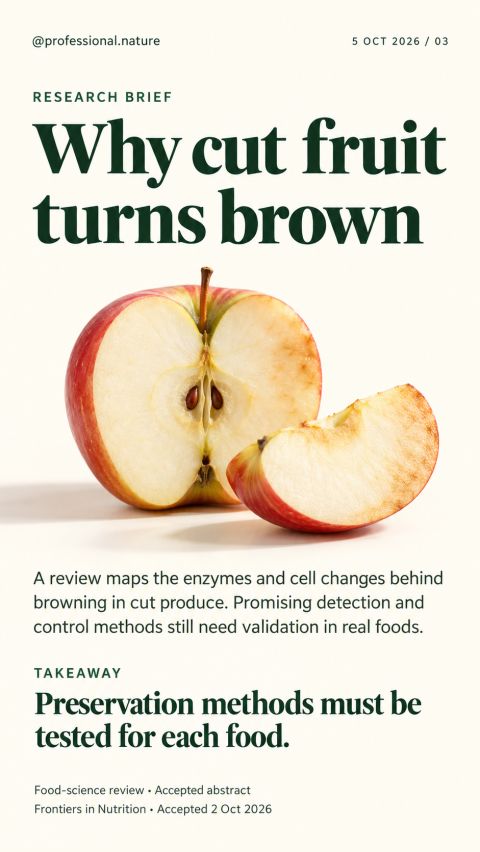
Why Cut Fruit Turns Brown
Fruit browning is a familiar change that occurs after foods such as apples, pears, bananas and avocados are cut or damaged. Although the change may look simple, several biological and chemical processes are involved.
What Happens After Cutting?
When a fruit is intact, many substances inside its cells remain separated. Cutting or bruising damages the cell structure and allows compounds that were previously separated to interact.
Enzymes can then come into contact with naturally occurring plant compounds and oxygen from the air. One of the most important enzymes involved is polyphenol oxidase, often called PPO.
This enzyme helps drive reactions that eventually produce brown-colored compounds on the exposed surface.
Why Does Browning Matter?
The color change does not automatically mean that a food has become unsafe. However, appearance can strongly influence whether consumers consider fruit fresh and appealing.
Changes after cutting may also involve texture, flavor and other quality characteristics. For food producers, understanding these processes can therefore be important for maintaining product quality and reducing unnecessary food waste.
Can It Be Slowed?
Several approaches can help slow enzymatic color changes. These may include reducing exposure to oxygen, changing acidity, controlling temperature or using suitable antioxidant treatments.
For example, acidic ingredients can reduce the activity of some enzymes, while refrigeration may slow the chemical and biological reactions occurring in freshly cut produce.
However, a preservation technique that works well for one type of food may not perform equally well in another. The characteristics of the fruit, processing conditions, storage environment and intended shelf life all need to be considered.
What Research Shows
Scientific reviews continue to investigate the enzymes and cellular changes responsible for browning in fresh produce. Researchers are also exploring methods for detecting and controlling these changes.
Promising techniques still require validation in real foods and under practical storage conditions before broad conclusions can be made.
Takeaway
Understanding fruit browning can help improve food quality and preservation. However, preservation methods should be evaluated for each food rather than assuming that one approach will work equally well for every product.