Can AI Count Your Nutrients?
AI nutrient estimation is becoming increasingly common in nutrition apps and digital health tools. A photo, food name or meal description can now produce an estimated nutritional profile within seconds. But how accurate are these results?
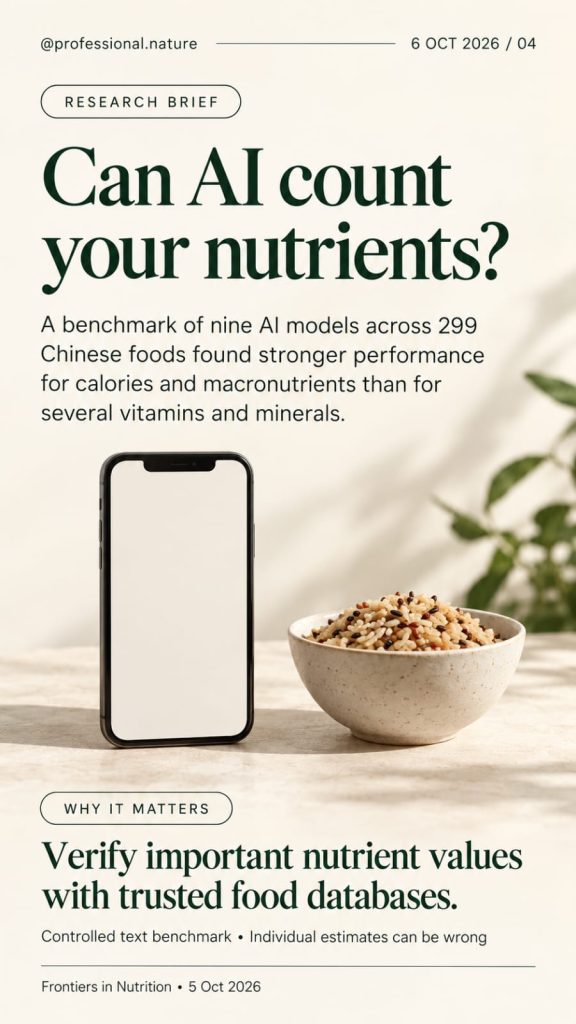
A recent study compared nine AI models using 299 Chinese foods. Researchers assessed how well the models estimated calories, macronutrients, vitamins and minerals.
Where Did AI Perform Better?
The models generally showed stronger performance when estimating calories and major macronutrients, such as protein, carbohydrate and fat.
These nutrients are often well documented in food composition databases, which may make them easier for AI systems to estimate.
However, performance was less consistent for several vitamins and minerals.
Why Are Micronutrients More Difficult?
The nutrient content of apparently similar foods can vary considerably. Variety, growing conditions, processing, preparation methods and serving size can all influence the final nutritional composition.
Micronutrients may be particularly difficult to estimate accurately when an AI system has limited information about the exact food or preparation method.
Why Verification Matters
AI can provide a convenient starting point for understanding a meal. However, an estimate should not automatically be treated as an exact laboratory measurement.
Small errors may not matter much for casual food tracking. Accuracy becomes more important when nutritional information is being used for clinical decisions, research, product formulation or management of specific dietary requirements.
Trusted food composition databases and verified product information remain important sources when precise values are required.
AI as a Nutrition Tool
Artificial intelligence has considerable potential in nutrition. It can make dietary tracking faster, help organize food information and make nutritional data easier to access.
However, users should understand its limitations. The quality of the result depends on the information provided to the model, the underlying data and the nutrient being estimated.
Takeaway
AI nutrient estimation can be useful, especially for quick assessments of calories and macronutrients. However, individual estimates can be wrong, particularly for some vitamins and minerals.
For important nutritional decisions, verify nutrient values using trusted food databases or other validated sources.