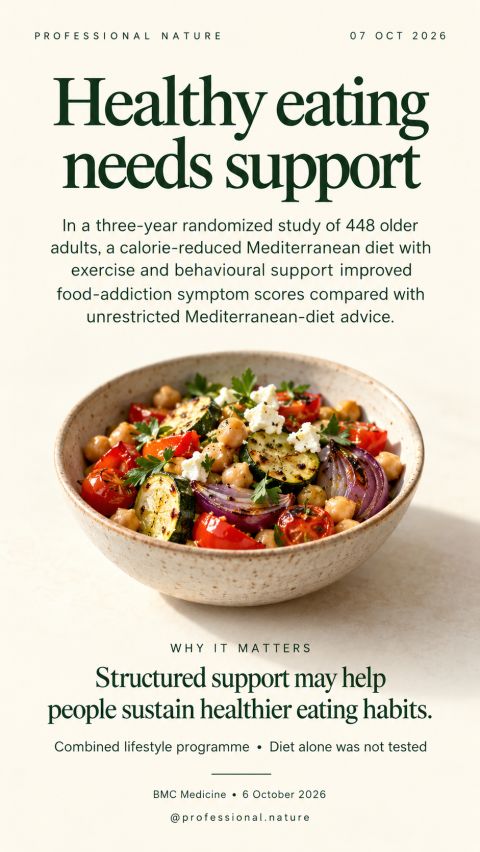
Healthy Eating Needs Support: What Research Shows
Healthy eating habits are an important part of long-term well-being. However, maintaining a balanced diet can be challenging, especially when people try to change established eating behaviors.
A three-year randomized study involving 448 older adults examined a structured lifestyle program. The intervention combined a calorie-reduced Mediterranean diet, physical activity and behavioral support.
Researchers reported improvements in food-addiction symptom scores compared with a group receiving advice to follow an unrestricted Mediterranean diet.
What Did the Study Find?
The study followed participants for three years and compared two approaches to dietary guidance.
One group received a structured program that included calorie reduction, exercise and behavioral support. The comparison group received advice to follow a Mediterranean dietary pattern without calorie restriction.
The structured intervention produced more favorable changes in food-addiction symptom scores.
These findings suggest that lifestyle programs may offer benefits beyond general dietary advice.
However, the research did not test the effects of diet, exercise and behavioral support separately.
Why Do Healthy Eating Habits Need Support?
Changing eating patterns involves more than choosing nutritious foods.
Daily routines, emotional responses, food availability and social environments can influence eating behavior.
Structured support may help individuals establish realistic goals, monitor progress and manage challenges.
For some people, regular guidance can make dietary changes easier to maintain over time.
What Is a Mediterranean Dietary Pattern?
A Mediterranean-style eating pattern generally emphasizes vegetables, fruits, legumes, whole grains, nuts and olive oil.
It also includes moderate amounts of other foods, depending on individual preferences and nutritional needs.
This dietary approach has been widely studied in relation to cardiometabolic health.
However, the benefits observed in this trial cannot be attributed solely to Mediterranean food choices.
Why Does Behavioral Support Matter?
Behavioral interventions can help people identify eating triggers, develop practical routines and improve consistency.
Support may include goal setting, progress reviews and strategies for managing difficult situations.
When combined with appropriate nutrition and physical activity, these approaches may support sustainable lifestyle changes.
Nevertheless, the most effective intervention can differ between individuals.
What Are the Study Limitations?
Although the trial included 448 participants and lasted three years, the findings relate to a specific older adult population and a combined intervention.
The study did not establish whether calorie restriction, exercise or behavioral guidance independently produced the observed improvements.
Changes in food-addiction symptom scores also should not be interpreted as proof that the program treats every form of disordered eating.
Takeaway
Healthy eating habits may be easier to maintain when nutrition guidance is combined with structured lifestyle support.
This randomized study suggests that a comprehensive program can improve certain eating-related symptom scores compared with general Mediterranean-diet advice.
The findings highlight the potential value of personalized nutrition, physical activity and behavioral strategies.
Research source: BMC Medicine, 6 October 2026.