Coffee and Cancer: What Does New Research Reveal?
Coffee and cancer have become important topics in nutritional epidemiology. Researchers are investigating whether regular coffee consumption is associated with the risk of developing different types of cancer.
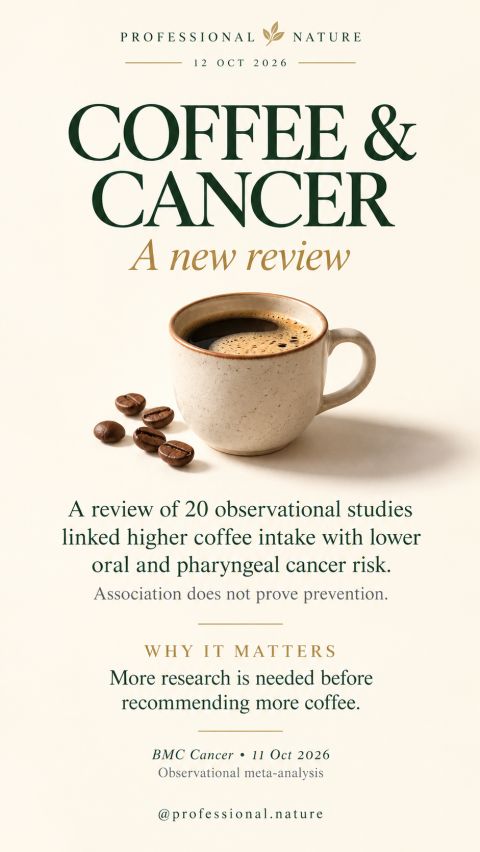
A meta-analysis published in BMC Cancer on 11 October 2026 reviewed 20 observational studies. The researchers reported an association between higher coffee consumption and lower risk of oral and pharyngeal cancers.
However, these findings do not establish that coffee prevents cancer.
What Did the Research Find?
The review combined evidence from 20 observational studies examining coffee consumption and cancer risk.
The overall findings suggested that people reporting higher coffee intake had a lower risk of oral and pharyngeal cancers.
These results provide useful information about possible relationships between dietary habits and cancer outcomes.
However, observational research cannot independently determine whether coffee consumption caused the difference in risk.
Other factors may influence the association.
Why Are Researchers Interested in Coffee?
Coffee contains numerous naturally occurring compounds, including caffeine, chlorogenic acids and other polyphenols.
Scientists have investigated some of these substances for their antioxidant properties and possible effects on cellular processes.
Laboratory studies have also explored how coffee-related compounds interact with pathways associated with inflammation and oxidative stress.
However, biological activity observed in laboratory experiments does not automatically translate into cancer prevention in humans.
Understanding Oral and Pharyngeal Cancers
Oral cancer affects structures within the mouth, while pharyngeal cancer involves parts of the throat.
These cancers have several established risk factors.
Tobacco use, alcohol consumption and certain viral infections can contribute to risk, depending on the cancer type and anatomical location.
Understanding these factors is essential when interpreting research on coffee consumption.
For example, differences in smoking or alcohol habits between coffee drinkers may influence observational results.
Does Drinking More Coffee Prevent Cancer?
No. The available findings do not prove that increasing coffee intake prevents oral or pharyngeal cancer.
Even a meta-analysis that combines multiple observational studies remains limited by the design and quality of the underlying research.
Researchers must consider potential confounding factors, differences in coffee preparation and variations in consumption patterns.
The results also cannot establish an ideal daily coffee intake for cancer prevention.
Why Does Study Design Matter?
A meta-analysis combines findings from several studies to identify broader patterns.
This approach can improve the overall understanding of a research question.
However, combining observational studies does not transform their associations into proof of causation.
Differences in participant characteristics, dietary assessment methods and study quality may affect the conclusions.
Further research is needed to clarify the biological and clinical significance of the reported relationship.
Should People Increase Their Coffee Intake?
The findings do not justify recommending additional coffee specifically to prevent cancer.
Individual caffeine tolerance varies, and excessive consumption may cause sleep disturbances, anxiety or palpitations in susceptible people.
Coffee consumption should be considered within the context of overall health, medication use and personal preferences.
Avoiding tobacco, limiting alcohol and following appropriate preventive healthcare recommendations remain more established approaches to reducing relevant cancer risks.
Why Does This Research Matter?
The relationship between coffee and cancer deserves continued scientific investigation because coffee is widely consumed.
Large observational datasets may help researchers identify associations worth exploring in future studies.
However, nutrition recommendations should distinguish between promising research findings and clinically established preventive strategies.
Takeaway
Coffee and cancer research suggests a possible association between higher coffee consumption and lower oral and pharyngeal cancer risk.
A meta-analysis of 20 observational studies reported this relationship, but the findings do not demonstrate that coffee prevents cancer.
More research is needed before recommending increased coffee consumption as a cancer-prevention strategy.
Research source: BMC Cancer, 11 October 2026 — Observational Meta-analysis.