Fasting and Liver Fat: Does Time-Restricted Eating Help?
Fasting and liver fat have become important topics in metabolic health research. Scientists are investigating whether limiting daily eating hours can help reduce fat accumulation in the liver.
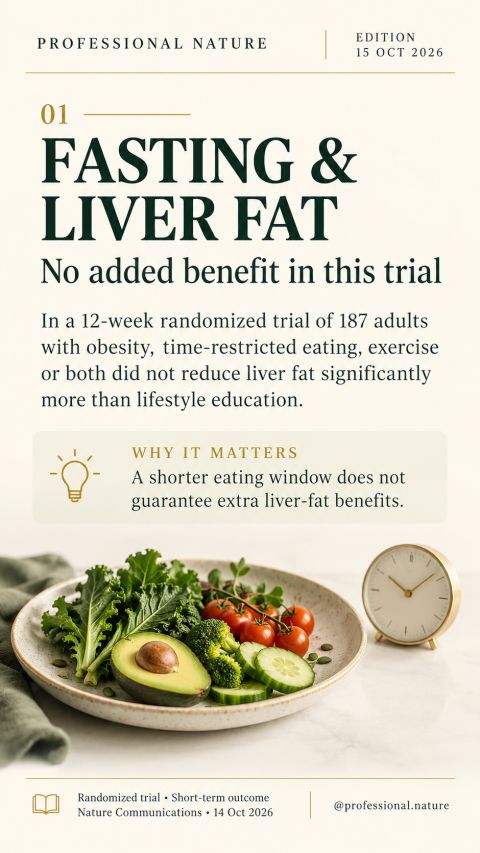
A randomized clinical trial published in Nature Communications on 14 October 2026 examined 187 adults living with obesity over 12 weeks.
The study compared time-restricted eating, exercise and a combination of both with lifestyle education.
Researchers found that none of these interventions produced a statistically significant additional reduction in liver fat compared with lifestyle education.
These findings highlight the importance of evaluating dietary strategies through controlled clinical research.
What Did the Study Find?
The trial investigated whether specific lifestyle interventions could improve liver fat outcomes.
Participants followed different intervention strategies involving restricted eating hours, exercise or both.
The researchers compared these approaches with lifestyle education.
After 12 weeks, the interventions did not demonstrate significantly greater liver fat reductions than the comparison approach.
This result does not mean that participants experienced no changes. Instead, the study did not establish a statistically significant additional benefit between the evaluated groups.
What Is Time-Restricted Eating?
Time-restricted eating is a dietary approach that limits food consumption to a defined period each day.
For example, individuals may consume their meals within a particular daily eating window.
Unlike some traditional diets, this approach primarily focuses on when food is consumed rather than prescribing specific foods.
Researchers are studying whether meal timing influences metabolic processes, energy regulation and cardiometabolic health.
However, results can vary depending on the population, intervention duration and overall dietary habits.
Why Does Liver Fat Matter?
The liver plays an essential role in nutrient metabolism, energy regulation and numerous biological processes.
Excessive fat accumulation in the liver can be associated with metabolic dysfunction.
In some individuals, this condition may contribute to inflammation, liver injury and other health complications.
Metabolic dysfunction-associated steatotic liver disease, or MASLD, is a common condition linked to metabolic risk factors.
However, liver fat measurements alone do not provide a complete assessment of liver health.
Clinical evaluation may require additional laboratory tests, imaging and medical assessment.
Does Fasting Reduce Liver Fat?
The relationship between fasting and liver fat is still being investigated.
Some studies have reported improvements in metabolic measurements following time-restricted eating.
However, findings differ across study designs and participant groups.
In this particular trial, restricting eating hours did not produce a statistically significant additional reduction in liver fat compared with lifestyle education.
Therefore, the results do not support the assumption that a shorter eating window always provides superior liver-related benefits.
What About Exercise?
Regular physical activity is widely recommended as part of a healthy lifestyle.
Exercise can support cardiovascular fitness, muscular function and metabolic health.
However, this study focused on whether the tested exercise intervention produced additional liver fat reduction over 12 weeks.
The researchers did not observe a statistically significant advantage compared with lifestyle education.
This finding should not be interpreted as evidence that exercise lacks broader health benefits.
Why Might Lifestyle Education Matter?
Lifestyle education can help individuals understand healthy eating patterns, physical activity and other behaviors that influence metabolic health.
Such programs may encourage sustainable changes in daily routines.
Because the comparison group received lifestyle education, the study did not compare the interventions with receiving no support at all.
This distinction is important when interpreting the findings.
A lack of additional benefit does not necessarily mean that every intervention was ineffective.
What Are the Study Limitations?
The trial included 187 adults living with obesity and lasted 12 weeks.
Although randomization strengthens the study design, the relatively short duration limits conclusions about long-term outcomes.
The findings may not apply equally to individuals with different health conditions, body weights or dietary patterns.
Additionally, the absence of a statistically significant difference does not prove that all approaches are equivalent.
Larger and longer studies may help clarify which individuals benefit most from specific interventions.
Should Everyone Follow a Fasting Diet?
Not necessarily.
Dietary approaches should reflect individual health conditions, nutritional requirements and personal circumstances.
Time-restricted eating may be unsuitable for certain people, including those with specific medical conditions, eating disorders or medication schedules that require food intake.
People considering major dietary changes should seek appropriate professional guidance.
A sustainable and nutritionally adequate eating pattern remains an important foundation for metabolic health.
Why Does This Research Matter?
Popular nutrition strategies often receive attention before researchers fully understand their long-term effects.
This trial provides evidence that combining or adding interventions does not always produce superior results for every measured outcome.
It also demonstrates why researchers must compare interventions with appropriate control groups.
The findings encourage a more individualized and evidence-based approach to metabolic health management.
Takeaway
Fasting and liver fat remain important areas of clinical investigation.
A 12-week randomized trial involving 187 adults with obesity found no statistically significant additional liver fat reduction from time-restricted eating, exercise or their combination compared with lifestyle education.
The results do not establish that fasting or exercise is universally ineffective.
Instead, they suggest that shorter eating windows do not guarantee additional liver fat benefits.
Long-term metabolic health requires a comprehensive approach based on individual needs and reliable scientific evidence.
Research source: Nature Communications, 14 October 2026 — Randomized Clinical Trial.