Coffee and Athletic Performance: Does Low-Dose Caffeine Help?
Coffee and athletic performance have attracted considerable scientific attention. Many athletes consume coffee before training or competition, hoping to improve energy, concentration and physical performance.
However, the effects of caffeine may depend on the dose, exercise type and individual response.
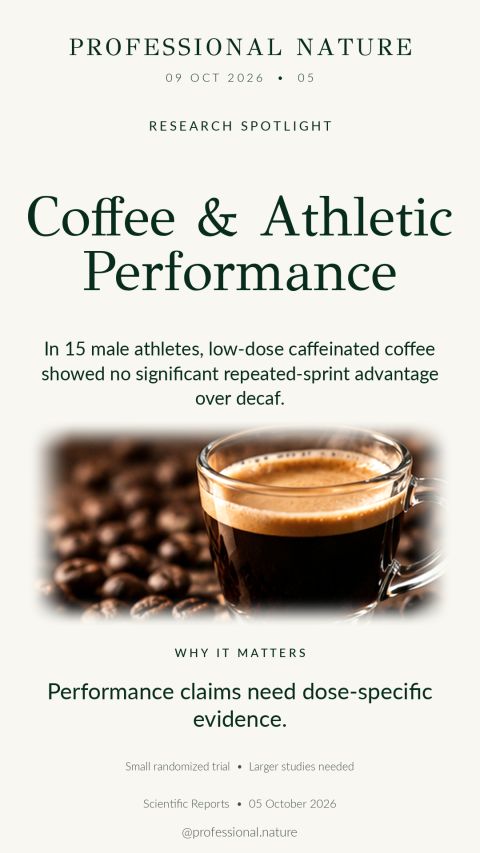
A small randomized trial involving 15 male athletes investigated whether low-dose caffeinated coffee improved repeated-sprint performance compared with decaffeinated coffee.
The researchers found no statistically significant advantage from the caffeinated coffee condition.
What Did the Study Find?
The study examined repeated-sprint performance after participants consumed either low-dose caffeinated coffee or decaffeinated coffee.
Researchers compared the athletes’ responses under the two conditions.
The results showed no significant improvement in repeated-sprint performance following the low-dose caffeinated coffee.
This finding suggests that consuming a small amount of caffeine through coffee does not necessarily enhance every type of athletic activity.
However, the absence of a statistically significant difference does not prove that caffeine has no effect under other conditions.
Why Is Caffeine Studied in Sports Nutrition?
Caffeine is a naturally occurring stimulant found in coffee, tea and several other beverages.
It primarily acts on the central nervous system by blocking adenosine receptors. This mechanism can influence alertness and perceived fatigue.
Previous sports nutrition research has examined caffeine in relation to endurance, strength, power and high-intensity exercise.
However, performance responses can vary according to caffeine dose, timing, habitual consumption and exercise demands.
Does Coffee Improve Sprint Performance?
Not necessarily.
Repeated-sprint exercise requires athletes to produce high-intensity efforts with limited recovery periods.
Although caffeine may improve certain performance measures in some settings, results are not consistent across all sports and testing protocols.
The current trial found no significant advantage from low-dose caffeinated coffee compared with decaffeinated coffee.
Therefore, its findings should not be generalized to higher caffeine doses or different forms of exercise.
Why Does Caffeine Dose Matter?
Caffeine dose is an important consideration when evaluating performance-related claims.
A low dose may produce different effects from the doses investigated in other sports nutrition studies.
Individual sensitivity, body weight, sleep quality and regular caffeine intake may also influence responses.
Higher doses are not automatically better. Excessive caffeine can cause unwanted effects, including anxiety, sleep disturbances and palpitations.
Athletes should consider their personal tolerance and seek appropriate professional guidance when using caffeine strategically.
What Are the Study Limitations?
The trial included only 15 male athletes, making it a relatively small investigation.
Its findings may not apply to female athletes, recreational exercisers or other athletic populations.
The study also focused on repeated-sprint performance rather than all aspects of physical performance.
Larger studies are needed to clarify whether different coffee preparations, caffeine doses or exercise protocols produce different results.
Takeaway
Coffee and athletic performance remain important topics in sports nutrition research.
This small randomized trial found no statistically significant repeated-sprint advantage from low-dose caffeinated coffee compared with decaffeinated coffee.
The findings highlight why performance claims should consider caffeine dose, exercise type and individual variability.
Coffee may have a place in an athlete’s routine, but its benefits should not be assumed for every activity or every person.
Research source: Scientific Reports, 5 October 2026.