Gut Microbes and Vaccine Fever: What Research Reveals
Gut microbes play an important role in human biology, including digestion, metabolism and immune system regulation. Scientists are increasingly investigating how intestinal bacteria may influence the body’s response to vaccination.
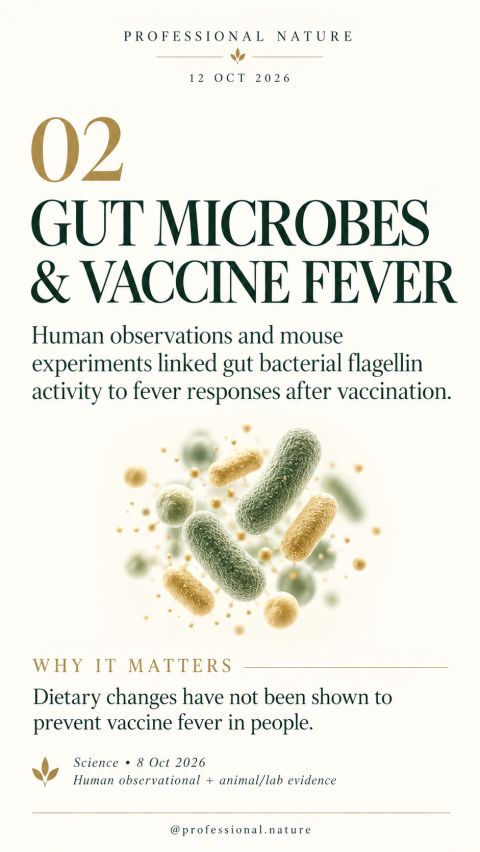
A study published in Science on 8 October 2026 explored the relationship between bacterial flagellin activity and fever following vaccination.
The research combined human observations with animal experiments. Its findings suggest that certain microbial signals may contribute to post-vaccination fever responses.
However, the study does not establish that changing the diet or gut microbiome can prevent vaccine-related fever in humans.
What Did the Researchers Find?
Researchers investigated whether activity associated with bacterial flagellin was linked to fever after vaccination.
The findings identified a relationship between microbial flagellin-related activity and fever responses in human observations.
Mouse experiments provided additional evidence supporting a possible biological mechanism.
Together, these results suggest that signals originating from intestinal bacteria may influence how the immune system responds following vaccination.
However, the human evidence was observational. It cannot independently establish a direct cause-and-effect relationship.
What Is Bacterial Flagellin?
Flagellin is a structural protein found in the flagella of many bacteria.
Flagella are structures that help certain microorganisms move through their environment.
The immune system can recognize flagellin through specialized receptors involved in detecting microbial components.
One such receptor is Toll-like receptor 5, commonly called TLR5.
Recognition of bacterial signals can activate immune pathways involved in inflammation and host defense.
However, not all intestinal bacteria produce flagellin, and microbial communities vary considerably between individuals.
Why Can Fever Occur After Vaccination?
Vaccines stimulate the immune system to recognize specific pathogens or their components.
During this process, some people experience temporary symptoms such as mild fever, fatigue or soreness.
These reactions can reflect activation of immune and inflammatory pathways.
However, fever is not required for a vaccine to be effective.
The presence or absence of fever does not reliably indicate the level of protection developed after vaccination.
How Might Gut Bacteria Influence Immune Responses?
The intestinal microbiome interacts with the immune system through several mechanisms.
Microorganisms produce compounds and structural components that can influence immune signaling.
Researchers are investigating whether these interactions affect individual differences in responses to vaccines.
The current study adds evidence that flagellin-related pathways may be relevant to post-vaccination fever.
Nevertheless, identifying a biological pathway does not automatically establish a safe or effective clinical intervention.
Can Diet Prevent Vaccine Fever?
There is currently insufficient evidence to conclude that dietary changes prevent fever after vaccination.
Although nutrition can influence the gut microbiome, the relationship between food, microbial activity and immune responses is complex.
The study did not demonstrate that consuming particular foods, probiotics or supplements reduces post-vaccination fever in humans.
Therefore, people should not change vaccination schedules or use unproven dietary interventions based on these findings.
Why Does This Research Matter?
Understanding why individuals experience different reactions after vaccination may help scientists investigate the mechanisms of immune activation.
Research into microbial signaling could eventually contribute to better understanding of vaccine tolerability.
However, further human studies are needed before researchers can translate these findings into specific recommendations.
What Are the Study Limitations?
The research included observational evidence from humans and experimental findings from mice.
Animal experiments can help explore biological mechanisms, but their results do not always translate directly to humans.
Human observational associations also cannot establish that bacterial flagellin activity independently causes fever.
Additional controlled clinical studies are necessary to evaluate potential interventions.
Takeaway
Gut microbes may contribute to differences in fever responses after vaccination through bacterial signaling pathways.
Research published in Science identified associations involving flagellin activity, supported by experimental animal evidence.
However, the findings do not demonstrate that changing diet, taking probiotics or modifying the microbiome prevents vaccine-related fever in humans.
The study offers a promising direction for immunology research while highlighting the importance of further clinical investigation.
Research source: Science, 8 October 2026 — Human observational and animal experimental evidence.