Faster Eating in Infants: Does It Mean More Calories?
Infant eating speed is an emerging topic in early-life nutrition research. Scientists are exploring whether the pace at which babies eat relates to energy intake, appetite regulation and growth.
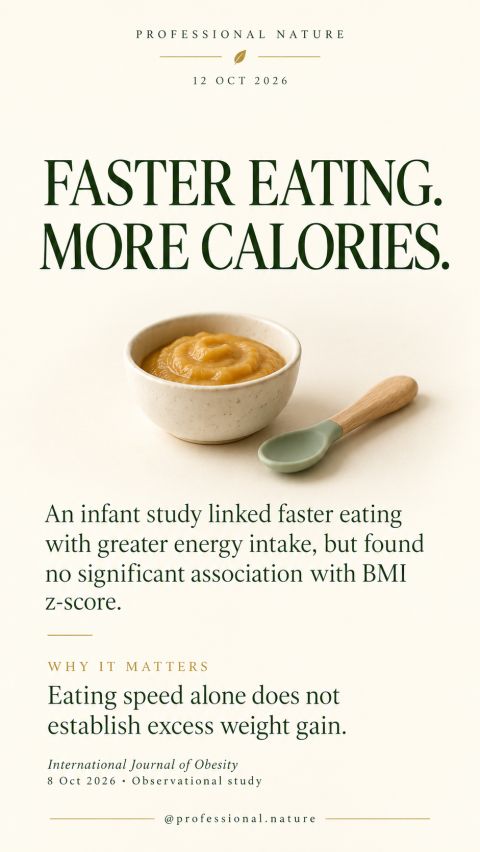
An observational study published in the International Journal of Obesity reported that faster eating was associated with greater energy intake among infants.
However, researchers did not find a statistically significant association between eating speed and BMI z-score.
These findings highlight an important distinction: consuming more calories during eating does not necessarily establish excess weight gain.
What Did the Study Find?
Researchers examined relationships between eating speed, energy intake and body mass index adjusted for age and sex.
The results showed that infants who ate faster tended to consume more energy.
However, the study did not identify a significant relationship between eating speed and BMI z-score.
This suggests that eating behavior and body-size measurements do not always follow the same pattern.
Because the study was observational, it cannot determine whether eating faster directly caused greater energy intake.
Why Does Infant Eating Speed Matter?
Eating behavior develops during early childhood and may vary considerably between infants.
Some babies eat quickly, while others require more time to complete a feeding session.
These differences can reflect hunger, feeding experience, developmental stage and individual temperament.
Researchers study such behaviors to understand how appetite regulation develops during infancy.
However, eating speed alone is not a reliable indicator of nutritional health.
Understanding Energy Intake
Energy intake refers to the calories consumed through food and beverages.
Infants require sufficient energy to support rapid growth, organ development and daily physiological functions.
Their nutritional needs depend on factors such as age, growth patterns and individual health.
Higher energy intake during a particular meal does not automatically indicate overfeeding.
Researchers must consider overall intake, growth trends and other relevant factors.
What Is BMI Z-Score?
BMI z-score is a standardized measurement that describes how an individual’s BMI compares with an age- and sex-specific reference population.
Researchers sometimes use this measure to examine growth-related patterns.
However, BMI is not a complete measure of infant health or nutritional status.
Healthcare professionals generally assess infant growth using appropriate age-specific growth charts, including weight-for-length or length-for-age measurements when relevant.
Growth should be evaluated over time rather than from one measurement alone.
The Role of Responsive Feeding
Responsive feeding involves recognizing and responding appropriately to an infant’s hunger and fullness cues.
Caregivers can support positive feeding experiences by allowing suitable time for meals and avoiding pressure to finish food.
A calm and supportive feeding environment may help children develop healthy relationships with food.
However, the current study did not establish that changing feeding speed improves weight outcomes.
What Are the Study Limitations?
The research used an observational design.
Therefore, it identified associations rather than proving cause and effect.
Other factors, such as developmental stage, food texture, feeding practices and individual appetite, may influence eating behavior.
The absence of a significant association with BMI z-score also does not prove that eating speed has no relationship with future growth outcomes.
Longer studies are needed to explore these questions.
Why Does This Research Matter?
Understanding early eating behaviors may help researchers identify factors related to infant nutrition.
However, nutritional recommendations should rely on a broad assessment of feeding practices, growth and developmental needs.
Focusing on one behavior without considering the overall context may lead to misleading conclusions.
Takeaway
Infant eating speed was associated with greater energy intake in an observational study.
However, researchers found no statistically significant association between eating speed and BMI z-score.
These findings suggest that faster eating does not automatically indicate excess weight gain.
Infant nutrition should be evaluated through appropriate growth monitoring, balanced feeding practices and individualized professional guidance.
Research source: International Journal of Obesity, 8 October 2026 — Observational Study.