Personalized Nutrition: How Personal Can Dietary Advice Get?
Personalized nutrition is becoming an important area of scientific research. Instead of recommending exactly the same eating pattern for everyone, researchers are exploring how individual health information could help tailor dietary advice.
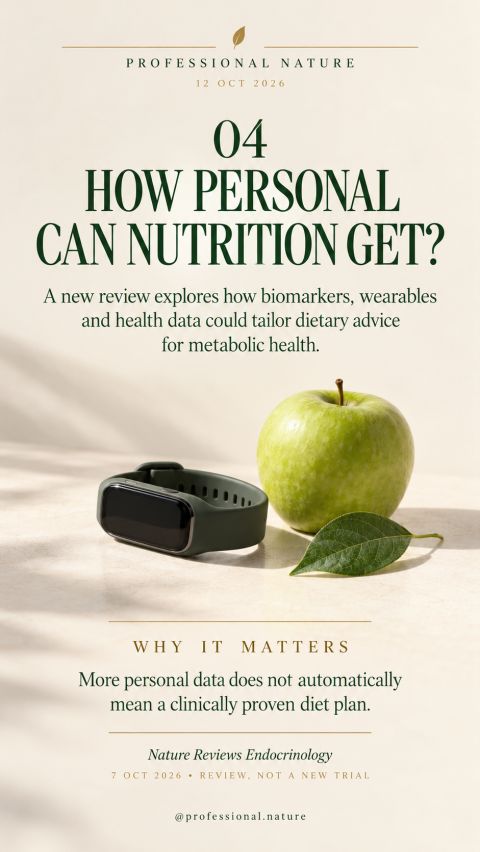
A review published in Nature Reviews Endocrinology examines how biomarkers, wearable technologies and health data may contribute to more individualized nutritional strategies.
However, having more personal information does not automatically mean that a dietary recommendation is clinically effective.
What Is Personalized Nutrition?
Personalized nutrition aims to adapt dietary recommendations to individual characteristics.
These may include age, activity levels, health conditions, metabolic responses and nutritional needs.
Traditional dietary guidelines provide useful recommendations for large populations. Individualized approaches attempt to build on this foundation by considering differences between people.
For example, two individuals may respond differently to similar meals because of variations in metabolism, medication use or lifestyle.
Researchers are investigating whether these differences can help guide more effective dietary strategies.
How Can Biomarkers Help?
Biomarkers are measurable indicators of biological processes or health conditions.
Examples include blood glucose, blood lipids and certain markers of nutritional status.
These measurements can provide information about how the body processes nutrients and responds to dietary changes.
However, not every measurable biomarker is useful for selecting a specific diet.
Researchers must establish whether using a particular marker actually improves meaningful health outcomes.
The Role of Wearable Technology
Wearable devices can collect information about physical activity, sleep and other physiological measurements.
Some technologies also support continuous monitoring of specific metabolic indicators.
These tools may help researchers understand daily patterns that are difficult to capture through occasional clinical measurements.
For example, activity and sleep data could provide additional context when evaluating dietary habits.
Nevertheless, wearable measurements can vary in accuracy. More data does not necessarily lead to better nutritional decisions.
Can Artificial Intelligence Improve Dietary Advice?
Artificial intelligence may help analyze large amounts of nutritional and health information.
Researchers are exploring how computational models could identify patterns and support individualized recommendations.
However, these systems depend on the quality of their data and the reliability of their predictions.
An algorithm that predicts a biological response does not automatically produce a diet that improves long-term health.
Clinical validation remains essential.
Why Does Metabolic Health Matter?
Metabolic health involves processes related to blood glucose regulation, lipid metabolism and energy balance.
These processes can vary between individuals.
Understanding such differences may help researchers develop more targeted nutritional interventions.
However, scientists still need to determine which personalized approaches provide advantages over established dietary guidance.
What Are the Current Limitations?
The publication is a scientific review rather than a new randomized clinical trial.
It discusses emerging technologies, research opportunities and limitations in the field.
Important challenges include measurement accuracy, data privacy, accessibility and the need for independent clinical validation.
Researchers must also establish whether personalized recommendations produce sustainable improvements in health.
Without this evidence, collecting additional personal data may increase complexity without improving outcomes.
Does Everyone Need a Personalized Diet?
Not necessarily.
Many established nutrition principles remain relevant across populations.
A varied diet, appropriate energy intake and adequate consumption of essential nutrients provide an important foundation.
Individualized advice may be especially useful when specific medical conditions, nutritional deficiencies or clinical needs require tailored management.
However, personalized nutrition should complement evidence-based care rather than replace it.
Takeaway
Personalized nutrition offers promising opportunities to combine biomarkers, wearable technology and health information.
These tools may eventually help healthcare professionals tailor dietary advice more precisely.
However, scientific progress requires more than collecting data. Researchers must demonstrate that personalized strategies improve meaningful clinical outcomes.
The future of nutrition may become increasingly individualized, but reliable evidence remains essential.
Research source: Nature Reviews Endocrinology, 7 October 2026 — Scientific Review.