Urolithin A: Mixed Results for Brain and Vascular Health
Urolithin A has attracted scientific interest for its potential effects on cellular health, metabolism and ageing. Researchers are investigating whether this compound may influence blood-vessel function and brain responses.
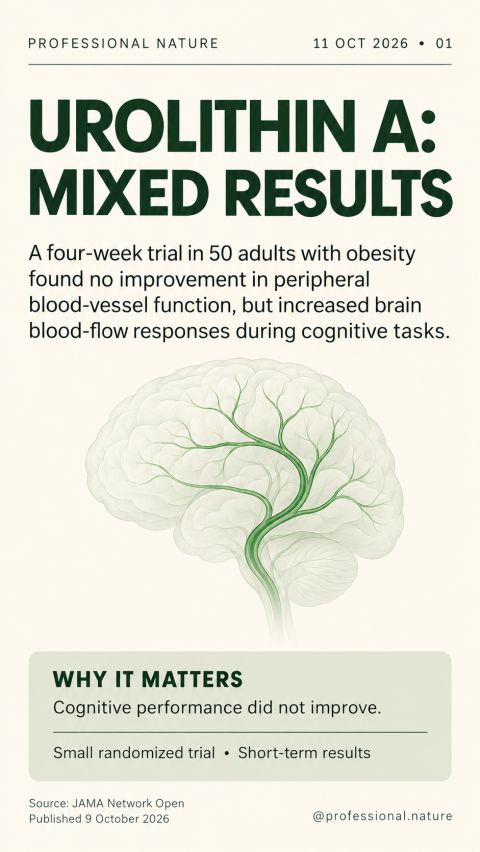
A small randomized clinical trial published in JAMA Network Open examined 50 adults living with obesity over four weeks.
The study reported increased brain blood-flow responses during cognitive tasks. However, researchers found no significant improvement in peripheral blood-vessel function or cognitive performance.
These findings highlight the importance of distinguishing physiological changes from meaningful clinical benefits.
What Is Urolithin A?
Urolithin A is a compound that can be produced by certain gut microorganisms from ellagitannins and related substances found in foods such as pomegranates, walnuts and some berries.
The ability to produce this compound naturally varies between individuals because gut microbiome composition differs.
Researchers have investigated urolithin A for its possible effects on mitochondrial function and cellular processes associated with ageing.
However, promising biological mechanisms do not automatically establish clinical benefits.
What Did the Clinical Trial Find?
The randomized study included 50 adults with obesity and lasted four weeks.
Researchers examined vascular responses and cognitive outcomes.
The results showed no significant improvement in peripheral vascular function, which concerns blood-vessel performance outside the brain.
However, participants receiving the intervention demonstrated increased cerebral blood-flow responses during cognitive tasks.
Importantly, this physiological change was not accompanied by measurable improvements in cognitive performance.
Why Is Brain Blood Flow Important?
The brain requires a continuous supply of oxygen and nutrients to support normal activity.
Blood flow can change in response to cognitive demands, reflecting interactions between neural activity and the vascular system.
Researchers study these responses to better understand cerebrovascular function.
However, an increase in blood-flow response does not necessarily mean better memory, concentration or overall brain health.
Clinical outcomes must be evaluated separately.
Does Urolithin A Improve Cognitive Performance?
This trial did not demonstrate an improvement in cognitive performance.
Although researchers observed changes in cerebral blood-flow responses, participants did not show corresponding cognitive benefits during the study period.
Therefore, the findings do not support claims that urolithin A improves memory or mental performance in the population studied.
Longer and larger trials are needed to determine whether the physiological changes have clinical significance.
What About Vascular Health?
Healthy blood vessels support circulation and nutrient delivery throughout the body.
The study assessed peripheral vascular function but did not identify a significant improvement after the intervention.
This result is important because it shows that changes in one physiological measurement do not necessarily translate into broader vascular benefits.
What Are the Study Limitations?
The trial involved only 50 adults and lasted four weeks.
This relatively small sample and short duration limit the conclusions that can be drawn about long-term effects.
The findings may not apply to individuals without obesity or to other age groups and clinical populations.
Further independent research is necessary to evaluate effectiveness, safety and appropriate use.
Why Do These Results Matter?
Nutritional compounds are often promoted based on their potential biological mechanisms.
However, a compound may influence laboratory or physiological measurements without improving outcomes that matter directly to patients.
This study illustrates why researchers must evaluate both biological responses and clinical performance.
Takeaway
Urolithin A produced mixed findings in a small randomized trial involving adults with obesity.
Although cerebral blood-flow responses increased during cognitive tasks, researchers found no significant improvement in cognitive performance or peripheral vascular function.
The findings support further investigation but do not establish that urolithin A improves brain function or cardiovascular health.
Research source: JAMA Network Open, 9 October 2026.